
How to Measure Cycle Time per Workflow State in Azure DevOps
Learn how to measure Azure DevOps cycle time per workflow state, identify bottlenecks with cumulative flow, and find where delivery work actually waits.
September 24, 2026
AI workplace tools often get grouped together as monitoring. Here is the line between surveillance and performance intelligence that actually helps people.
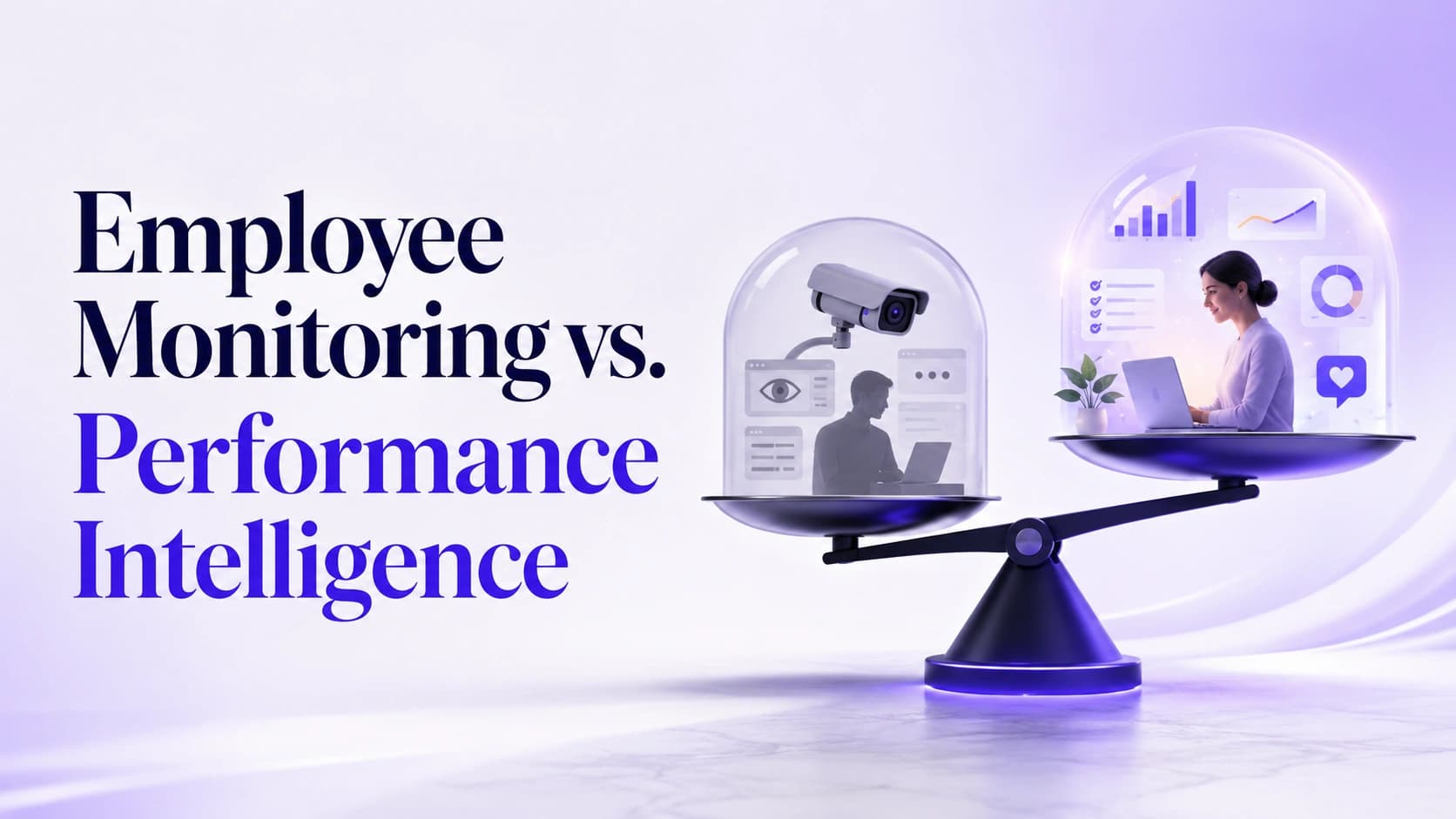
As AI tools enter HR and management workflows, employees are asking the right question: is this monitoring me? Leaders should not dodge that question. The answer depends on purpose, data, visibility, and how outputs are used.
Performance intelligence is meant to help managers understand context and act earlier. Employee monitoring is meant to observe individual activity. Those are not the same category, and treating them as interchangeable is a trust problem.
The line between helpful insight and surveillance is not subtle. Monitoring starts with observation of the person. Performance intelligence starts with work context and managerial support.
A monitoring tool asks, “What is this employee doing right now?” A performance intelligence system asks, “What pattern should a manager understand before the next conversation?”
The first can create pressure and fear. The second can create clarity, provided the system is designed with boundaries.
Employee monitoring tools often focus on time online, keystrokes, screenshots, app usage, idle time, location, or device activity. The data is usually tied to a named individual and presented as proof of productivity.
That framing creates three problems.
First, activity is not performance. Someone can send many messages and still create confusion. Someone can be quiet and still unblock a critical decision.
Second, monitoring changes behavior. People optimize for visibility instead of value. They may stay online longer, split work into more visible fragments, or avoid focused work that looks inactive from the outside.
Third, monitoring damages trust. Once employees believe a tool is watching them rather than helping their manager understand context, every insight becomes suspect.
Performance intelligence should focus on patterns that help a manager investigate, support, recognize, or coach. It should not produce a verdict about a person.
The best systems look across goals, feedback, work progress, collaboration, recognition, and manager notes. They do not say, “This employee is good” or “This employee is bad.” They surface context such as declining recognition, repeated blockers, delayed feedback, uneven collaboration, or a team that has not had meaningful manager contact in weeks.
That is why an evidence standard matters. The quality of the insight depends on what evidence is used, how current it is, and whether the manager can inspect the context behind it.
A monitoring system might say someone was inactive for two hours.
A performance intelligence system might show that the person has been assigned repeated urgent work, has received little feedback, and has stopped participating in team discussions. The next step is not punishment. The next step is a manager check-in.
A monitoring system might rank employees by activity volume.
A performance intelligence system might show that one team has fewer recognition moments, fewer 1:1s, and more unresolved blockers than peer teams. The next step is manager coaching.
A monitoring system turns behavior into a score. A performance intelligence system turns context into a conversation.
HR should set boundaries before procurement, not after rollout.
The system should not use keystroke logging, screenshots, private-message surveillance, or hidden tracking as performance evidence. It should not make automated employment decisions. It should not encourage managers to treat activity volume as contribution. It should not produce a single score of employee worth.
The system should make its purpose clear to employees. It should explain what data is used, what data is not used, who can see outputs, and what decisions require human review.
This is exactly where AI governance becomes more than a legal checklist. Governance protects trust by defining how AI is allowed to support managers and what it is never allowed to decide.
HR teams are responsible for building systems employees can trust. That means privacy, fairness, explainability, and practical usefulness have to be considered together.
A tool can be technically impressive and still be wrong for the culture. If employees feel watched, they will not see the system as support. If managers receive outputs they cannot explain, they will either ignore the system or overtrust it.
HR teams need language that separates support from surveillance. They also need workflows that make that distinction real.
The safest design principle is simple: use AI to prepare managers, not to police employees.
That means the system should help managers notice patterns, prepare better questions, recognize specific contributions, and act sooner when something changes. It should also require human judgment before any output is used in a review, promotion discussion, compensation decision, or performance plan.
When employees understand that the purpose is support, not surveillance, the conversation changes. Managers can use signals without pretending signals are the whole person.
Once employees lose trust, even useful insights become hard to use. A pattern that could have helped a manager offer support may instead be interpreted as evidence that the company is watching people too closely.
That is why quiet disengagement is such an important test case. The goal should be to notice a change early enough to have a supportive conversation, not to label someone as disengaged because an algorithm detected a drop in activity.
Employee monitoring is the tracking of individual activity such as time online, app usage, screenshots, keystrokes, or device behavior.
Continue reading more insights from CatchUp AI