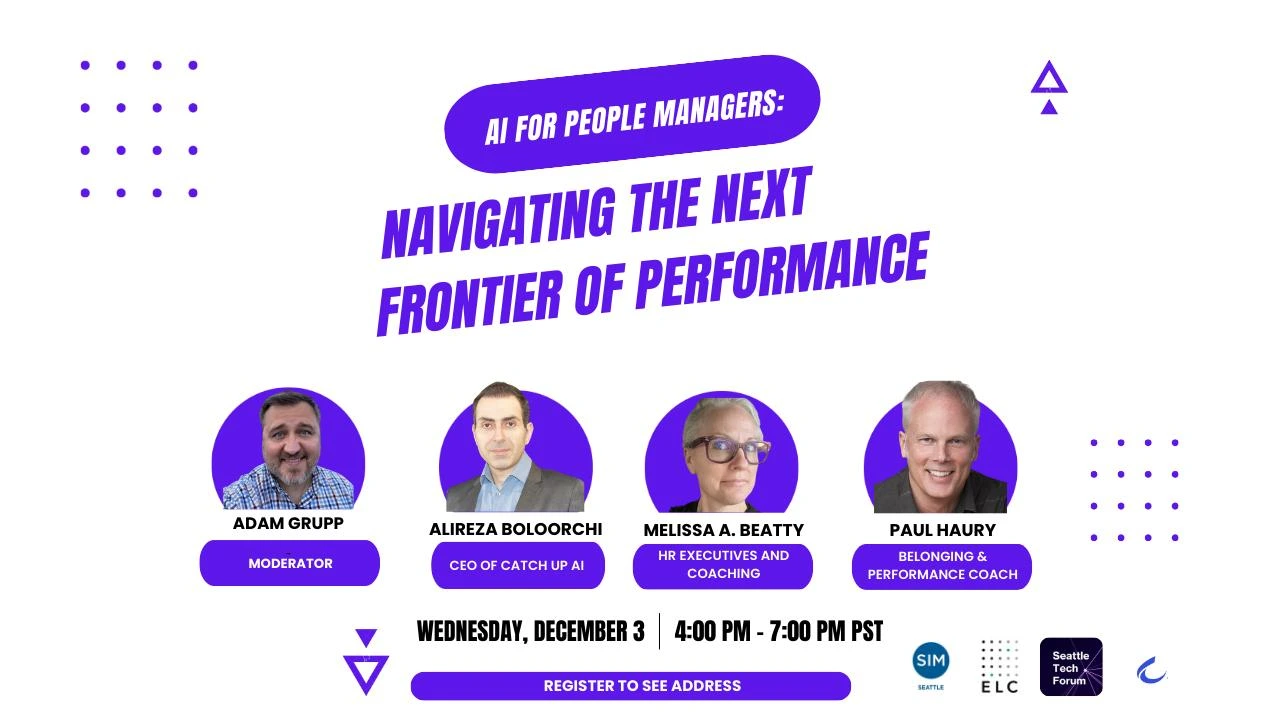
AI for People Managers: Navigating the Next Frontier of Performance
Discover how AI for people managers transforms performance management with data-driven insights, reduces bias, and creates personalized development plans.
Catch Up AI Team
Managing people effectively is a complex task, requiring clear communication, fair evaluations, and continuous feedback. In today's workplace, AI for people managers is rapidly changing how managers evaluate performance, provide feedback, and support their teams. With tools like MERIT Score, AI can turn performance signals into actionable insights, helping managers make data-driven decisions, reduce bias, and create more personalized employee development plans.
True modern performance management isn't about tracking keystrokes. It is about surfacing employee performance signals that help you coach better, write fairer reviews, and remove the guesswork from your 1:1s.
This guide outlines a practical framework to move from opinion-based management to evidence-based leadership.
What is AI Performance Management for People Managers?
Definition: AI for people managers refers to the use of artificial intelligence to aggregate work patterns, feedback, and output data into objective AI-driven performance insights. Unlike traditional surveillance, it focuses on summarization and pattern recognition to assist leaders in reducing bias and improving manager effectiveness metrics.
The Framework: Signals → Context → Coaching → Outcomes
To implement AI performance management effectively, you need a structured approach. We call this the SCCO Framework.
1. Signals (Data vs. Noise)
Most reviews are based on what a manager remembers from the last two weeks. AI changes this by collecting employee performance signals across the entire quarter. This includes code commits, design tickets, project completion rates, and peer recognition.
Goal: Capture the "invisible work" that often goes unnoticed.
Tool: Use people analytics for managers to visualize trends, not just moments.
2. Context (Human Interpretation)
Data without context is dangerous. A drop in output might mean an employee is slacking, or it might mean they are mentoring a junior hire.
Action: Use AI to summarize activity, but use your judgment to assign meaning.
Result: Fair performance reviews that account for circumstances, not just raw numbers.
3. Coaching (The Intervention)
Once you have the signal and context, you need to act. Manager coaching with AI can suggest talking points for data-informed 1:1s based on recent work patterns.
Feature: AI copilot workflows for managers can draft coaching plans that align with specific development goals.
4. Outcomes (Growth)
The end goal of continuous performance management is employee growth, not just assessment.
Metric: Track feedback and recognition analytics to ensure high performers feel valued and struggling employees get support.
The Skeptical Manager: Risks of AI in Performance Management (Surveillance, Trust, Bias)
If you are worried about risks of AI in performance management, you should be. Bad implementations destroy culture. Here is how to navigate the "Big Brother" problem.
Risk 1: The "Spyware" Perception
If your team thinks you are counting mouse clicks, trust evaporates.
Mitigation: Be transparent. Measure outcomes (deliverables), not activity (hours online). Focus on AI tools for HR and managers that prioritize aggregate impact over granular monitoring.
Risk 2: Algorithmic Bias
How to avoid bias when using AI for people's decisions? If an AI model is trained only on past promotion data, it may replicate historical prejudices.
Mitigation: Never let AI make the final decision. Use AI for reducing bias in performance reviews by surfacing forgotten achievements, but keep the "human in the loop" for the final rating.
Risk 3: Loss of Nuance
Performance signals vs opinions in reviews is a balancing act. AI creates a signal; it doesn't create the truth.
Mitigation: Use modern performance management tools that allow for qualitative peer feedback to sit alongside quantitative data.
Key Takeaway:
AI is a compass, not the captain. It shows you where to look, but you must decide where to steer the ship.
Practical Playbook: How to Implement AI Performance Management Step by Step
Here are practical steps that any people manager can implement starting this week to take advantage of AI-powered performance management:
Step 1: Integrate AI into Your Performance Reviews
Begin by using AI tools to gather performance signals from multiple sources. These insights will help you create more comprehensive and fair performance reviews.
Step 2: Set Up Continuous Feedback
Encourage a culture of continuous feedback where employees receive real-time insights about their performance. AI can automatically analyze signals and offer feedback, ensuring employees stay on track.
Step 3: Automate 1:1 Meetings
Use AI tools like Manager Buddy to automate the scheduling of 1:1 meetings. These tools can also generate discussion points, track progress on goals, and even suggest areas for coaching.
Step 4: Tailor Employee Development Plans
With AI insights, create personalized development plans for each team member. These plans should focus on improving skills and achieving long-term career growth, based on data and not just output.
The Skeptical Manager: Navigating Risks and Mitigations
As with any technology, AI in performance management comes with potential risks and challenges. It's important to approach AI adoption carefully:
Bias
AI systems are only as good as the data they are trained on. If the data is biased, AI tools can perpetuate existing inequalities. To mitigate this risk, ensure that AI tools are regularly updated and tested for fairness.
Surveillance Perception
Employees may feel that AI is being used to monitor them rather than assist in their growth. It's critical to foster an open conversation about how AI tools work and how they can help both managers and employees improve their performance.
Mismeasurement
Relying solely on AI for performance evaluations may overlook critical qualitative factors, such as emotional intelligence or team collaboration. Therefore, AI should complement, not replace, human judgment.
Key Takeaways
AI for people managers can improve the accuracy and fairness of performance reviews, help with real-time feedback, and offer personalized coaching insights.
The Signals → Context → Coaching → Outcomes framework is essential for effectively applying AI in performance management.
Be aware of risks such as bias and surveillance perception, and make sure AI tools are used transparently and responsibly.
Ready to transform your performance management?
Discover how AI can help you make data-driven decisions and reduce bias in performance reviews.
Frequently Asked Questions
AI analyzes employee performance signals to provide real-time insights. This ensures managers can make informed decisions, offer personalized feedback, and reduce bias in performance reviews.