Beyond the Resume: Why Verified Work Profiles (MERIT Score) Are the Future of Hiring
Stop relying on self-reported resumes. MERIT Score validates your skills using real-time continuous signals. Claim your verified proof of work.
Catch Up AI Team
Industry reports from HireRight, SHRM, and CareerBuilder indicate that roughly one in three to nearly half of resumes contain inflated or inaccurate information, placing the commonly cited estimate at around 40%.
In an era where Generative AI can craft a flawless—yet potentially fictional—work history in seconds, the traditional resume has lost its reliability. This has created a massive "Trust Gap" in the tech industry. Recruiters and hiring managers are no longer looking for self-reported claims; they are searching for proof of work.
To bridge this gap, the industry is shifting toward the Verified Work Profile. But what does that look like in practice?
What is a MERIT Score?
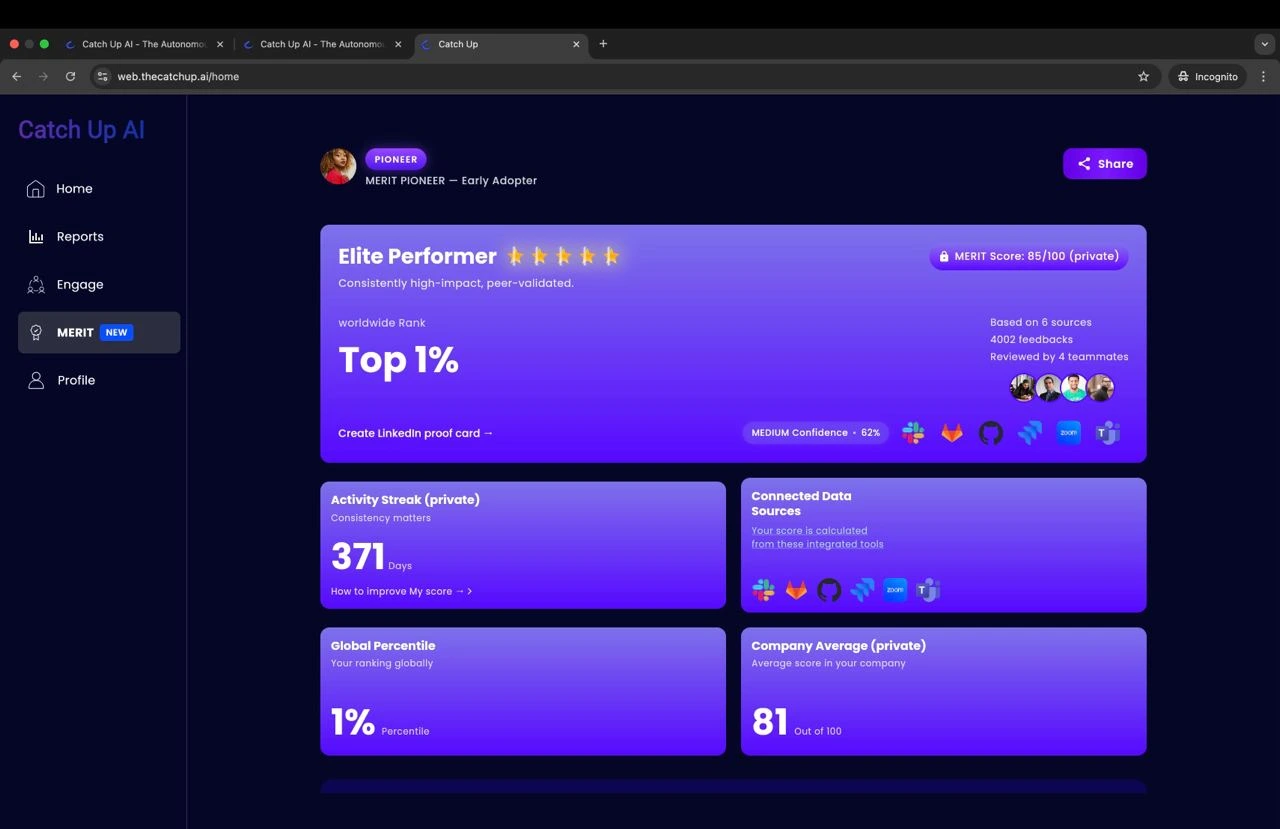
MERIT Score is a verified work profile that measures real professional impact using peer-validated feedback, behavioral work signals from collaboration tools, and consistency metrics over time, providing portable proof of work beyond traditional resumes.
Why Traditional Resumes and LinkedIn Are Becoming Less Reliable Signals
The core problem with the current hiring ecosystem is the reliance on self-reported data. Whether it is a PDF resume or a LinkedIn profile, the information is entirely curated by the candidate. This structure creates a significant "Trust Gap" between what a professional claims and what they can actually deliver.
In the digital age, we are witnessing Skill Inflation. Candidates often list every technology they have ever touched as a "core competency," making it impossible for recruiters to distinguish between an expert and a novice. LinkedIn endorsements attempt to solve this but often fail due to social bias; they are frequently exchanged as "quid-pro-quo" favors rather than objective assessments of ability.
Furthermore, traditional profiles focus heavily on pedigree bias—prioritizing university names and past job titles over current capabilities. This outdated model ignores the day-to-day reality of a tech professional's work. It fails to capture critical soft skills like collaboration, consistency, and problem-solving speed—metrics that truly define success in a modern engineering team.
What is MERIT Score and How Does It Work?
To replace the ambiguity of self-reporting, Catch Up AI introduced the MERIT Score. This system acts as a quantifiable professional reputation, aggregating data from the actual work environment to reduce early-stage uncertainty.
The MERIT Score engine calculates a professional's standing based on three verifiable pillars:
Verified Peer Feedback
Unlike casual social endorsements, this system gathers structured feedback from teammates who have actively collaborated with the user. It validates specific contributions and soft skills within the context of real projects.
Work Pattern Signals
MERIT Score uses behavioral metadata and interaction patterns from collaboration tools to surface consistent work rhythms and collaboration signals, without analyzing message content, code, or private communications. It seamlessly gathers data from the tools you use every day, including Slack, Microsoft Teams, Jira, GitHub, GitLab, and meeting platforms like Zoom and Google Meet.
Consistency Metrics
A resume shows a static snapshot of the past. MERIT Score tracks performance over time, highlighting a professional's ability to maintain high standards and grow their skillset continuously.
Ownership and Career Insurance
Perhaps the most critical feature of a MERIT Score is Data Ownership. In an unstable job market, your work history usually remains locked inside your employer's systems. MERIT Score extracts these "proof of work" signals and stores them in your private profile. In volatile job markets, this makes it a form of career insurance, a durable proof of work that remains valid through layoffs, role changes, and organizational shifts; Even if you leave a company or face a layoff, your verified reputation travels with you, serving as career insurance that proves your value to future employers instantly.
MERIT Score vs. Traditional Resume: The Evolution of Proof
The shift from resumes to verified work profiles is not about replacement, it's about signal quality. The table below highlights how MERIT Score differs structurally from traditional career artifacts.
Forward-thinking companies and hiring managers are increasingly relying on verified work profiles like MERIT Score because they solve three critical inefficiencies in the hiring process:
Faster, More Confident Decisions
Traditional hiring requires hours of technical screening and reference calls to verify a candidate's claims. A MERIT Score provides high-confidence, data-backed signals that can streamline early screening and reduce verification overhead in the hiring process.
Higher Signal Accuracy
Many talented engineers and product managers may not be expert resume writers. Verified data removes the bias of "keyword matching," allowing companies to discover high-performing talent based on actual output and collaboration history, rather than just polished formatting.
Better Culture and Team Fit
Beyond skills, teams succeed on reliability and interaction quality. Verified data surfaces how people work with others over time, helping companies reduce mis-hires and build healthier team dynamics.
This is why more organizations are choosing to supplement resumes rather than replace them, using objective and behavior-based signals to strengthen hiring decisions. Trust is no longer something that must be inferred. It is now something that can be measured.
The Future is Verified
The era of "fake it till you make it" is coming to an end. As the job market becomes more competitive and AI-driven, trust has become the new currency.
Your hard work, late nights, and team contributions shouldn't disappear the moment you leave a job. By building a verified work profile, you aren't just updating a document; you are taking ownership of your professional reputation.
MERIT Score represents the next evolution: a verified work profile built on real signals, peer validation, and consistency over time. It turns invisible work into visible evidence and gives professionals ownership over their professional reputation. In this new landscape, careers are no longer protected by storytelling alone, but by measurable impact.
Claim your MERIT Score for free and let your work speak for itself.
Frequently Asked Questions
Yes. Catch Up AI prioritizes user privacy and data ownership. Your MERIT Score is a private career asset that only you can see. You have full control over when and with whom you share your profile, ensuring your current employer or public network only sees what you choose to reveal.