
How to Measure Cycle Time per Workflow State in Azure DevOps
Learn how to measure Azure DevOps cycle time per workflow state, identify bottlenecks with cumulative flow, and find where delivery work actually waits.
September 24, 2026
Catch Up AI integrates with Lattice to add live signals, early alerts, private check-ins, and timely manager action to existing people workflows.
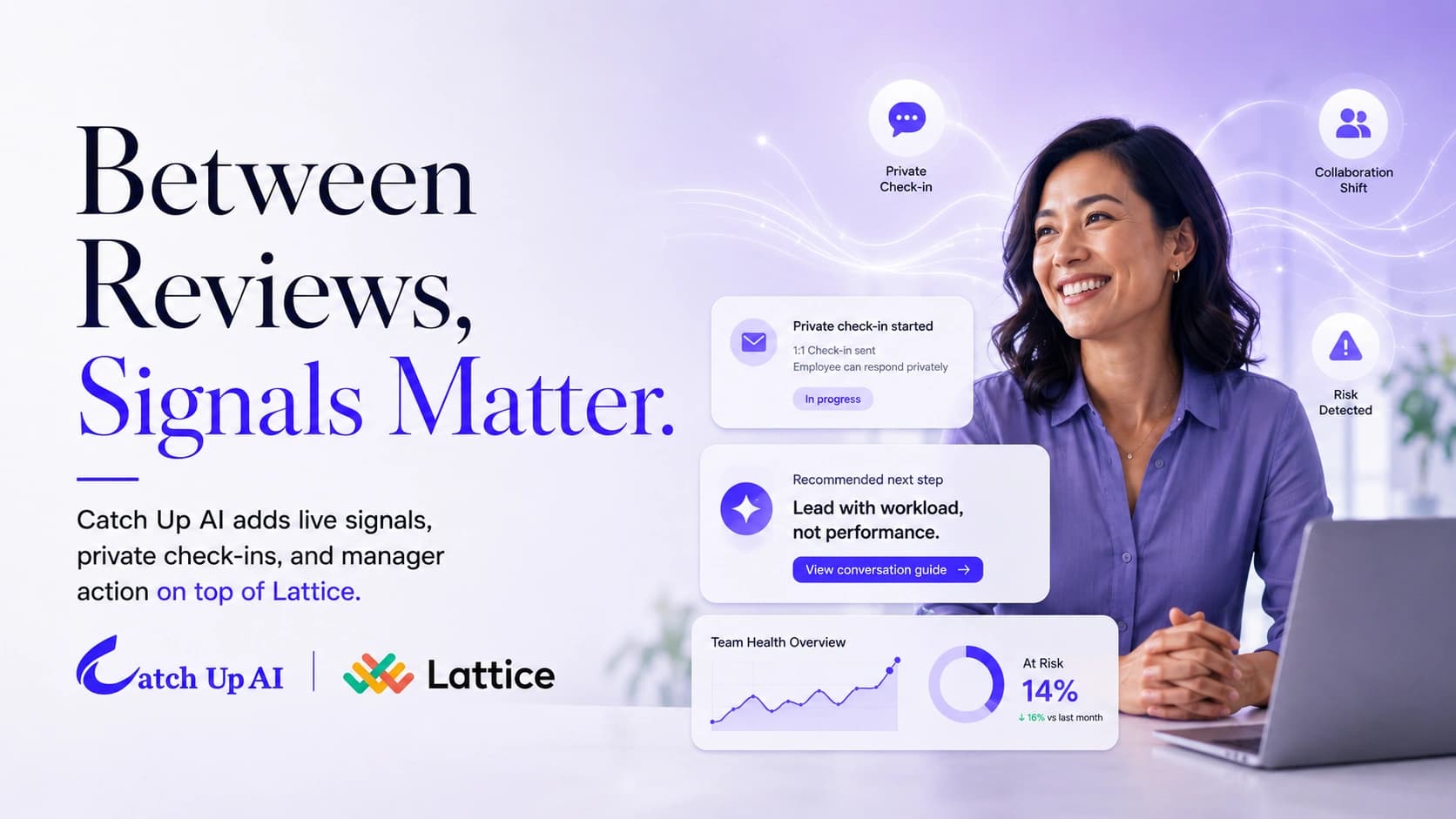
Most People teams do not have a platform problem. If you are running Lattice, you already have structured performance reviews, clear goals, engagement programs, and a rhythm of 1:1s that gives managers a real cadence to work with. That structure is valuable, and it is doing exactly what it was designed to do.
The harder question is not whether your people processes are organized. It is what happens between them, and who actually acts when something changes. Catch Up AI adds that live layer on top of the workflows People teams already trust, so signals can become timely support instead of another item waiting in a dashboard.
Your review cycle captures a moment. Your engagement survey captures a mood. Your 1:1 template gives managers a place to have the conversation. But the changes that lead someone to quietly disengage rarely wait for the next scheduled moment. They build up in the weeks in between, and even when a busy manager senses something, the follow-up often slips.
This article is about that gap, and how Catch Up AI, now integrated with Lattice, adds an autonomous layer on top of the workflows your People team already relies on. Not just to surface signals, but to act on them: reaching out, running the check-in, following up, and supporting both the manager and the employee before a preventable problem becomes a departure.
Disengagement and flight risk almost never announce themselves. They accumulate.
A dependable engineer starts pulling back from cross-team threads. A designer who used to unblock everyone goes quiet in reviews. A team hits the same blocker three sprints running and morale erodes. Someone's workload creeps up while their participation creeps down. A collaboration pattern shifts after a reorg.
None of these, on their own, means anything. People have busy weeks and heads-down projects. A single data point is noise, not insight. What matters is the pattern over time, viewed with context, and, crucially, whether anyone follows through in time to help.
The problem with formal cycles is not that they are weak. It is that they are periodic, and the follow-up depends entirely on a manager having the bandwidth, the context, and the right opening move at the right moment. That is a lot to ask of every manager, every week.
Plenty of tools can flag a pattern. They surface a chart, attach a risk score, and leave it on a dashboard a busy manager may never open. Detection alone changes nothing. A signal no one acts on is indistinguishable from a signal that was never generated.
This is the core distinction. A signal is not an intervention. The real value comes from what happens after detection: understanding why the change matters, reaching the right person at the right time, starting the right conversation, and following through.
Most platforms stop at the signal. Catch Up AI is built to carry it all the way through, autonomously.
Catch Up AI extends the instincts of your best managers to every employee, so your human managers can stay focused on strategic and technical leadership. In practice, the loop looks like this:
Detect → Understand → Reach out → Follow up → Support and act → Reassess
Here is what makes it different from a dashboard: Catch Up AI does not just tell a manager that something changed. It takes the next steps itself, on both sides of the relationship.
On the manager's side, it comes to them proactively inside Slack or Teams, not a separate tab, with the specific situation and the exact opening move. For example: a note that a team member is showing several disengagement signals across recent sprints, the relevant context, and a clear recommendation on how to open the conversation. Lead with workload, not performance. The manager gets a next move, not a data dump.
On the employee's side, Catch Up AI can run a lightweight, private check-in directly. It reaches out gently, asks whether the pressure is about workload, priorities, or something else, and offers practical help: narrow focus, sort through competing priorities, or draft talking points for an upcoming 1:1. The person gets support, not just a score.
And it is private by default. Those check-in conversations stay between the employee and Catch Up AI; only aggregated themes reach their manager, and only with the employee's consent. That consent model is what separates responsible manager intelligence from surveillance. The goal is to give people a safe place to surface what is really going on, early.
Four realistic scenarios. None is a diagnosis. Each is a starting point that the system helps carry through.
1. A previously active contributor goes quiet. Catch Up AI detects a multi-week drift in collaboration outside the person's normal baseline. It surfaces the likely context, such as a parallel migration doubling their context-switching, and privately checks in with the employee to see how things feel. In parallel, it hands the manager a prepared, workload-first opening for the next 1:1. The value is simple: a stretched, capable person feels supported before frustration hardens into a job search.
2. An invisible contributor keeps unblocking everyone. The system notices one person repeatedly moving others' work forward with no formal recognition. It flags a recognition moment to the manager and can capture the contribution as evidence for the next Lattice review. The person most likely to feel overlooked feels seen, and the review is grounded in real work.
3. A team hits repeated workload pressure. Recurring blockers and rising workload signals show up across a whole team, not one person. Catch Up AI escalates it as a team-level pattern with suggested talking points for a capacity conversation. A systemic problem gets addressed before it burns out multiple people.
4. A high performer shows possible flight-risk signals. Several engagement changes, together, warrant attention. Catch Up AI opens a private, supportive check-in with the employee and equips the manager for an honest, early conversation about growth and workload. This is where flight risk intelligence is most useful: not as a label, but as a prompt to understand what changed while there is still time to help.
None of this competes with your formal people processes. It makes them sharper and more continuous.
Managers walk into 1:1s already knowing what is worth discussing, and often after Catch Up AI has already surfaced the issue with the employee first. Performance reviews draw on evidence from real work across the whole cycle, which reduces recency bias. Recognition reaches the quiet contributors who usually get missed. Development, talent, and retention conversations start from a fuller picture, earlier.
Lattice remains the structured environment where your people programs live. Catch Up AI adds the autonomous awareness and follow-through that happen in the space between those structured moments, the everyday weeks where retention is actually won or lost.
Responsible manager intelligence is defined as much by its limits as its capabilities. Catch Up AI does not:
Signals are contextual, role-aware, and private by default. The system is designed to prompt earlier, better conversations and to handle the light-touch follow-up that usually falls through the cracks while your human managers stay focused on the strategic and technical leadership only they can provide.
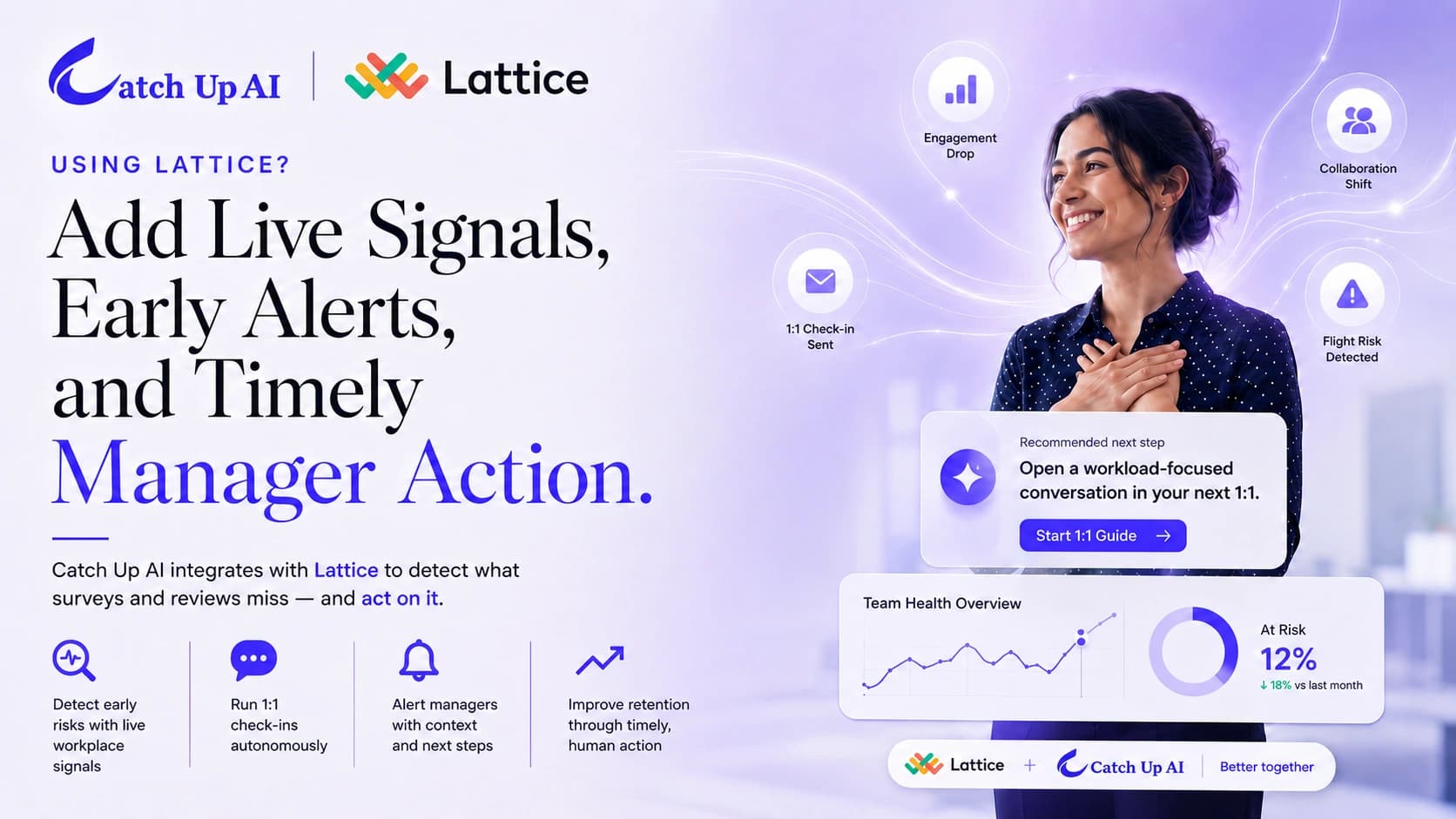
Lattice is already a powerful platform for performance and engagement. Now that Catch Up AI is integrated with Lattice, it adds an intelligent, autonomous layer on top of the workflows People teams already rely on, surfacing early signals, prioritizing what needs attention, and turning insight into timely action for both managers and employees.
Together, Lattice and Catch Up AI help organizations move from tracking performance and engagement to acting on what matters sooner.
To mark the integration, we are opening five complimentary implementation spots for organizations already using Lattice. We will help these five teams implement Catch Up AI at no cost and explore how a smarter Lattice experience can strengthen engagement, manager effectiveness, and employee retention.
Using Lattice? Apply to be one of the five teams.
Lattice gives your company a strong structure for people programs. Catch Up AI adds the live signals, private check-ins, follow-up, and manager action that happen in the space between those structured moments.
The goal is not to predict every resignation. No responsible system should claim that. The goal is to create more chances to notice, understand, and respond before a preventable problem becomes a departure. Retention is not won only in review season. It is won in the ordinary weeks in between, one timely, well-supported conversation at a time, and now those conversations do not depend on a busy manager catching everything alone.
Already using Lattice? See how Catch Up AI adds live signals, early alerts, and timely manager action on top of your existing workflow.
Yes. Catch Up AI is integrated with Lattice, adding an intelligent, autonomous layer on top of the workflows your People team already relies on. It brings live work context, early signals, and follow-up to your formal people cycles rather than replacing them.
Continue reading more insights from CatchUp AI