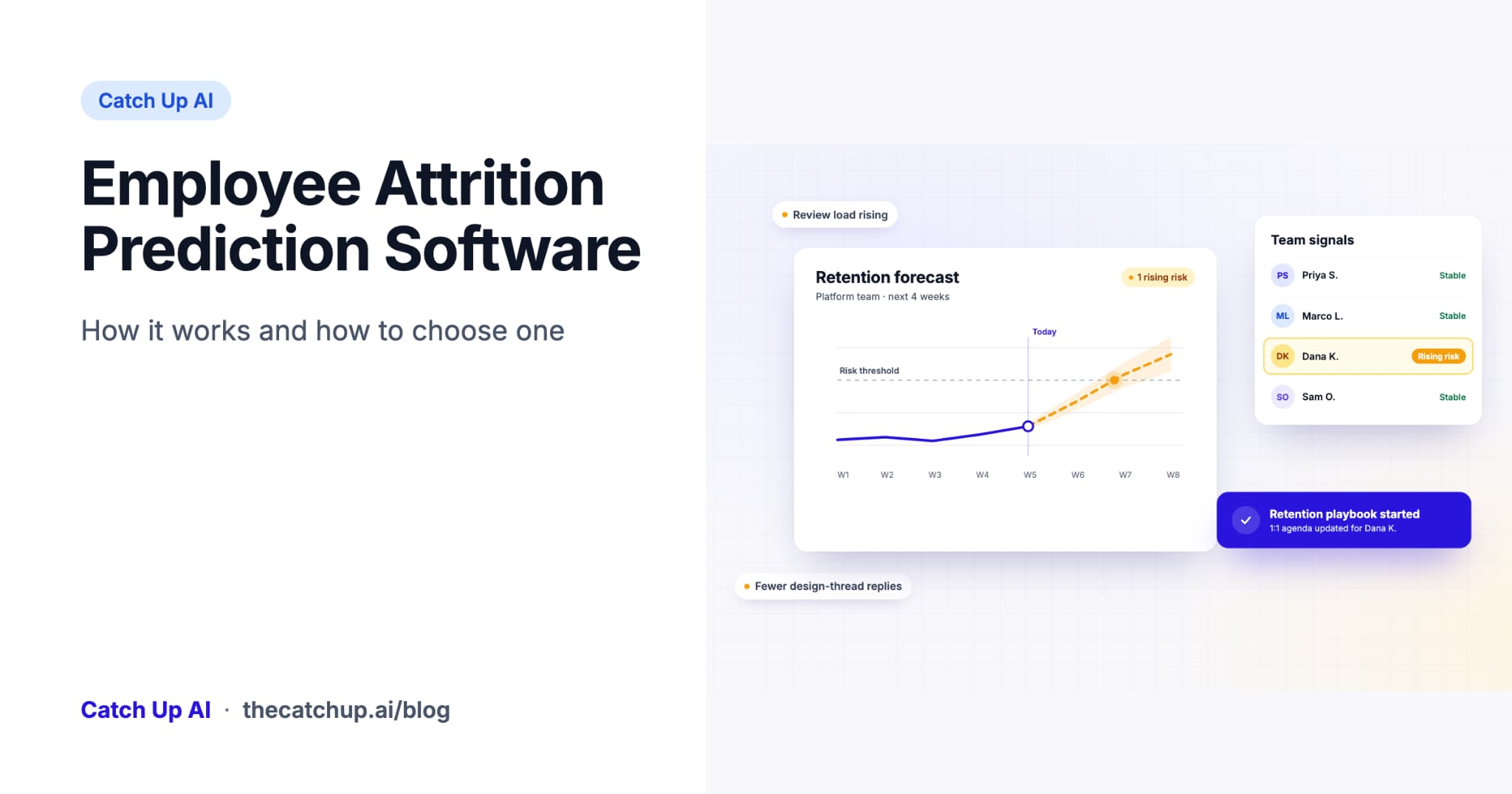
Employee Attrition Prediction Software: How It Works and How to Choose One
Learn how employee attrition prediction software works and compare 8 buying criteria, from data quality and accuracy to privacy and retention workflows.
October 23, 2026
Catch Up AI has been selected as a Venture Atlanta 2026 Showcase Company, recognizing its AI management layer for performance and retention.
Catch Up AI has been selected as a Showcase Company for Venture Atlanta 2026, recognizing the company as one of the Southeast's most promising technology companies. The conference takes place Wednesday, October 14 and Thursday, October 15 at The Woodruff Arts Center and Atlanta Symphony Hall in Atlanta, Georgia.
We are glad to be included, and we are more interested in the reason behind it. Venture Atlanta selects companies working on problems that matter to the way businesses will operate over the next decade. The problem we work on is narrow to describe and expensive to ignore: individual contributors have AI, companies are deploying AI agents across their operations, and the management layer is still running manually.
This article explains what that gap looks like inside a real organization, what an AI management layer does about it, and what we will be showing in Atlanta in October.
Venture Atlanta connects founders with investors, operators, and enterprise buyers across the Southeast and beyond. Showcase Companies are selected from a large applicant pool and presented to that audience as businesses worth watching.
See Venture Atlanta’s official announcement of the 2026 Showcase Companies on LinkedIn.
For us, the selection is external validation of a specific bet: that the next wave of enterprise AI value will not come only from giving employees better tools. It will come from giving managers better intelligence about the people and the agents they are responsible for.
Look at where AI budget has gone over the last three years.
Individual contributors received copilots, assistants, and generation tools. Engineering, support, sales, and marketing functions received agents that execute work end to end. Operations teams received automation that removes manual handoffs.
Managers received dashboards.
A people leader today is still expected to notice disengagement before it becomes a resignation, understand why a high performer's output changed, coach a struggling team member with specificity, and coordinate a team that increasingly includes both humans and AI agents. The tools available to do that are a quarterly or annual engagement survey, an HRIS record that updates when something has already happened, a performance review cycle that runs two to four times a year, and intuition.
Those inputs share a structural problem. They are periodic, they are self-reported, and they arrive after the decision window has closed. By the time a survey score drops or a review flags a concern, the employee has often already started looking. The conversation that could have changed the outcome needed to happen weeks earlier.
This is what we mean by the management layer operating manually. It is not that managers are not working hard. It is that they are being asked to make continuous decisions using discontinuous data.
An AI management layer sits between the systems where work happens and the manager who has to act. It has five jobs.
Every organization already generates a continuous record of how work is going. Project and issue trackers show how work moves. Code and delivery systems show throughput and review patterns. Communication and meeting tools show collaboration density. HRIS and payroll systems show tenure, role history, and compensation events. Knowledge and file systems show contribution.
Catch Up AI connects to more than thirty of these platforms across HRIS, payroll, engineering, project management, knowledge management, and file storage. The point is not to collect more data. The point is that the signals that predict attrition are already being produced as a byproduct of normal work, and no one is reading them together.
Catch Up AI converts those signals into a 90-day attrition forecast at the individual and team level.
An important distinction: a forecast is a probability, not a verdict. Catch Up AI does not claim to know with certainty who will resign, and no responsible system should. What a forecast does is rank where a manager's limited attention is most likely to change an outcome, and do it early enough that attention still matters.
A risk score with no explanation produces anxiety, not action. The useful output is context: which signals moved, in what direction, over what period, and what patterns they resemble.
A manager who sees "elevated risk" does nothing differently. A manager who sees that a senior engineer's review participation, cross-team collaboration, and project ownership have all declined over six weeks following a reorganization has something concrete to open a conversation with.
Catch Up AI delivers weekly manager nudges—short, specific prompts about what to look at and who to talk to this week. Not a report to read. A next action to take.
This is the difference between people analytics and management intelligence. Analytics tells you what happened to your organization. Management intelligence tells one manager what to do on Tuesday.
Catch Up AI does not make employment decisions, does not automate promotions, terminations, or compensation changes, and is not an employee monitoring product. The retention conversation is human work. The system's job is to make sure that conversation happens while there is still time for it to matter.
Retention is a timing problem more than an information problem. Most organizations eventually learn why someone left—in the exit interview, when nothing can be done with the answer.
The table below shows how the intervention window narrows as a departure progresses.
| Stage | Typical signal available | Who usually knows | Can the outcome still change? |
|---|---|---|---|
| Early disengagement | Shifts in collaboration, ownership, and delivery patterns | Usually no one | Yes—this is the widest window |
| Passive looking | Reduced discretionary effort, withdrawal from long-horizon work | Sometimes a peer | Yes, with a specific and credible conversation |
| Active searching | Calendar and availability changes, scope reduction | Rarely the manager | Sometimes, and usually at a higher cost |
| Offer in hand | The resignation conversation | The manager, now | Rarely, and a counteroffer is a poor instrument |
| Exit interview | A full and honest explanation | Everyone | No |
Every row down that table costs more and works less often. The value of an AI management layer is that it operates in the top row, where the cost of acting is a thirty-minute conversation rather than a backfill, a search fee, and six months of lost institutional knowledge.
There is a second reason this layer is becoming necessary, and it is newer.
Teams are no longer only people. A manager in 2026 may be responsible for eight engineers and a set of agents that write code, triage tickets, draft documentation, and run parts of the delivery pipeline. Capacity planning, work allocation, quality review, and performance conversations all change shape when part of the team is not human.
Managers have no established practice for this. There is no playbook for deciding which work goes to an agent and which work goes to the person who is developing toward a senior role, or for noticing when automation has quietly hollowed out the work that made someone's job meaningful.
We believe that is a management problem before it is a tooling problem, and that the companies that handle it well will be the ones whose managers have intelligence about both halves of the team.
We have seen these repeatedly, and we design against them:
An AI management layer is software that sits between the systems where work happens and the people who manage teams. It reads operational and HR signals continuously, forecasts risks such as attrition, explains the likely drivers, and prompts managers to act. It is distinct from people analytics, which reports on the past, and from HRIS, which records state.
Continue reading more insights from CatchUp AI