
How to Measure Cycle Time per Workflow State in Azure DevOps
Learn how to measure Azure DevOps cycle time per workflow state, identify bottlenecks with cumulative flow, and find where delivery work actually waits.
September 24, 2026
Learn how AI performance management software turns work signals into explainable context, manager action, and responsible follow-up.

Performance shifts between reviews: a project stalls, valuable work goes unnoticed, or a team begins collaborating differently.
AI performance management software connects authorized workplace signals with performance context, explains meaningful changes, and helps managers decide what to do next. It provides earlier evidence and a clearer path to responsible action, not automatic judgments about employees.
Most companies do not lack performance data. They lack a reliable way to connect it, interpret it, and turn it into timely follow-up.
AI performance management software organizes performance information, identifies relevant patterns, supports reviews and coaching, and recommends next steps. It may combine goals, feedback, 1:1 notes, HRIS records, surveys, recognition, and signals from work tools.
Traditional software is usually built around scheduled events. AI-powered performance management can make the process more continuous by surfacing context that deserves attention now, rather than asking a manager to reconstruct six months of work from memory.
Catch Up AI is designed as a performance and retention intelligence layer connecting existing tools to manager action, not another system of record or a replacement for managers.
Scheduled reviews create structure, but they also create blind spots. Managers may remember the latest project more clearly than earlier work. Quiet contributors receive less visibility, and feedback often arrives after the moment when it would have helped.
Dashboards do not automatically solve this. A score or alert without explanation may give HR visibility while leaving managers unsure what to do next.
Real-time performance management should close that gap. It should help answer practical questions:
Work signals are patterns generated through normal work systems. They can come from project delivery, collaboration, goals, feedback, recognition, meetings, or people data. Examples include a sustained change in delivery pace, repeated blockers, reduced cross-team interaction, or unusually high context switching.
The important word is pattern. One late task is not a performance problem, and fewer messages do not prove disengagement. A signal becomes useful only when it is compared with relevant context and reviewed by someone who understands the situation.
Companies already generate this information across Slack, Microsoft Teams, Jira, GitHub, GitLab, Zoom, Azure DevOps, HR systems, and surveys. Each tool holds only one part of the story. Our guide to how HRIS, survey workplace signals work together explains why combining sources is more reliable than treating one signal as a conclusion.
An effective performance intelligence platform should do more than collect data. It should create a traceable workflow from observation to follow-up. Catch Up AI's Autonomous Performance Manager follows this broader signal-to-action model.
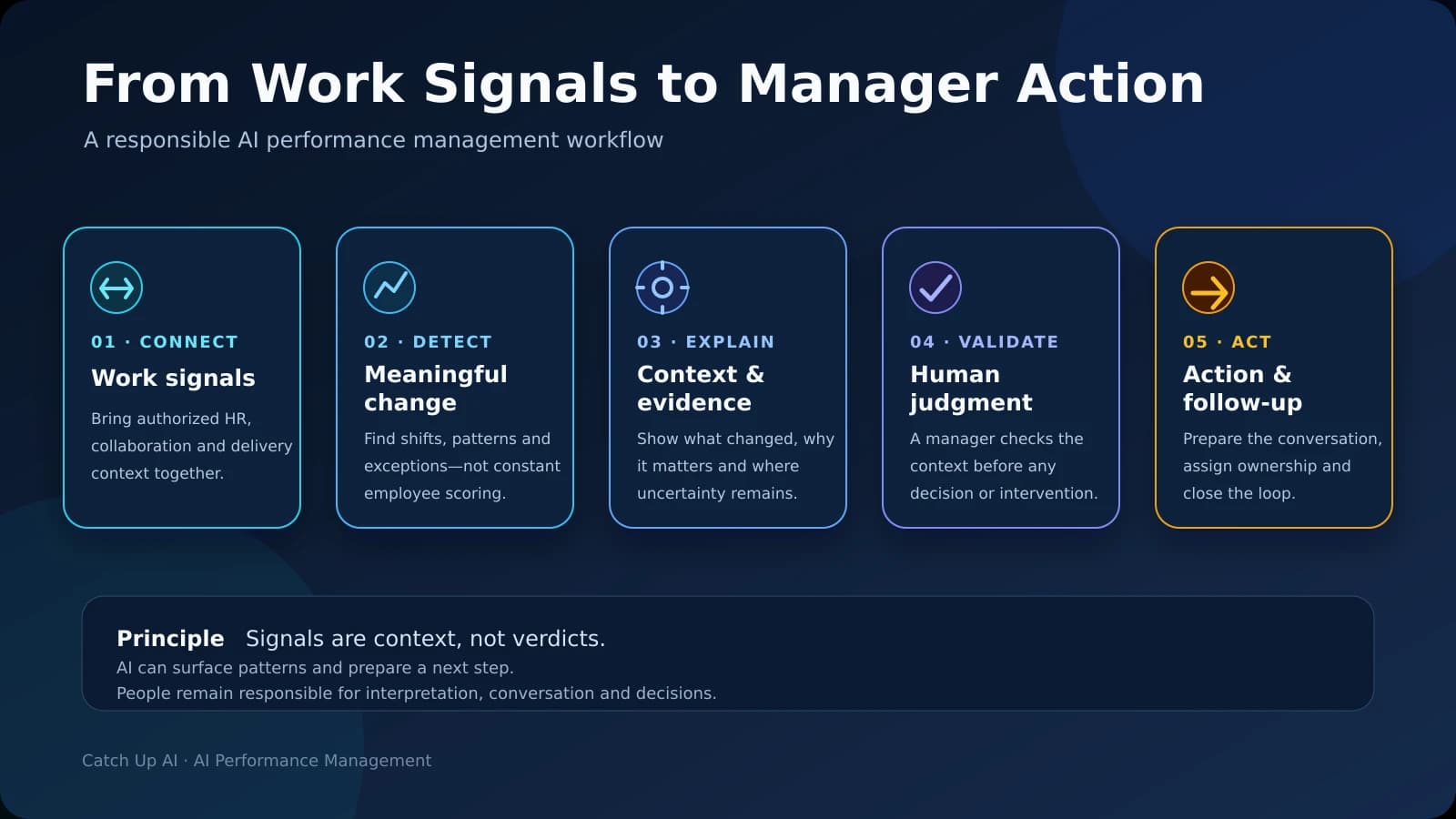
The system connects approved sources. HRIS data provides organizational context; goals and reviews show expectations; collaboration and delivery tools show how work is moving now. Manager input adds what the systems cannot know.
More data is not automatically better. The goal is the minimum context required for a legitimate performance workflow.
AI can identify shifts and exceptions that are difficult to notice across several tools. The useful output is not a permanent employee ranking, but a focused indication that something deserves a closer look.
A manager should see why a signal appeared: the supporting pattern, timeframe, and relevant evidence. Explainability gives managers something concrete to validate instead of a black-box score.
A workload signal may reflect a difficult assignment, planned leave, or a temporary launch period. The manager reviews the evidence and decides whether it is relevant. AI supports judgment; it does not own the decision.
The action may be a supportive 1:1, clearer priorities, recognition, coaching, or no action. Good software prepares the next step and makes ownership visible. An insight lost in a dashboard has not improved performance.
The value is clearer when capabilities are tied to management moments rather than presented as a list of AI features.
| Management moment | Useful AI support | Human responsibility |
|---|---|---|
| Preparing a performance review | Gather relevant evidence and organize themes | Evaluate the evidence and write a fair final assessment |
| Planning a 1:1 | Surface changes, blockers, and prior commitments | Listen, ask questions, and agree on next steps |
| Recognizing contribution | Identify specific, less-visible work | Decide what deserves recognition and deliver it authentically |
| Supporting performance improvement | Track patterns and documented follow-up | Set expectations, coach, and assess progress |
| Responding to retention risk | Explain possible drivers and urgency | Validate the situation and choose an appropriate intervention |
For review cycles, Review Now AI helps managers turn notes and workplace context into a structured draft with strengths, development areas, and recommendations. The manager remains responsible for the final evaluation.
Flight Risk Intelligence applies the same principle to retention: it can surface early patterns and prioritize attention, but a risk indication is a conversation prompt, not proof that someone will resign.
The difference is not simply that one product includes an AI writing assistant.
| Traditional performance management | AI performance management |
|---|---|
| Organized around fixed review cycles | Supports continuous performance awareness |
| Relies heavily on manager memory | Brings forward relevant evidence from multiple sources |
| Stores goals, ratings, and forms | Connects patterns, context, and next actions |
| Reports what has already been documented | Can highlight meaningful change between formal cycles |
| Ends when a review or survey is submitted | Supports coaching, action ownership, and follow-up |
An AI review writer can save time, but writing faster is not the same as managing performance better. Continuous performance intelligence helps managers notice, understand, validate, and act.
Workplace signals require boundaries. Visible activity should not be confused with value; message counts, attendance, or task volume can mislead without role and team context.
A responsible system should follow four rules:
This matters for distributed and technical teams, where deep work can look like low activity. Explainable signals and human validation are what make the output useful.
The software is most useful when managers oversee complex work across several systems and HR cannot manually connect every signal, particularly in growing companies, distributed teams, and engineering organizations.
Do not ask only, “Does this platform have AI?” Ask, “Can it show managers what deserves attention, explain why, and help them complete the right follow-up?”
No. AI can organize evidence, identify patterns, prepare drafts, and suggest next steps. Managers remain responsible for understanding context, speaking with employees, making decisions, and evaluating outcomes.
It should not be. Employee monitoring focuses on observing activity. Responsible performance intelligence uses limited, relevant signals to support specific management workflows, with explanation, human validation, and clear boundaries.
It may use goals, reviews, feedback, recognition, HRIS records, surveys, 1:1 notes, and authorized collaboration or project signals. Sources should depend on the use case and the organization's data policies.
AI can bring forward evidence from across the review period instead of relying on recent memory. It cannot guarantee an unbiased review; managers must still assess relevance and fairness.
An autonomous performance manager is an AI-supported workflow that continuously detects relevant changes, explains evidence, recommends manager actions, and tracks follow-up. “Autonomous” should describe workflow support, not unsupervised decisions about employees.
Look for transparent evidence, configurable integrations, human approval, privacy controls, useful manager workflows, and follow-up tracking. Be cautious of platforms that present opaque scores or promise certain predictions about human behavior.
The future is not a larger dashboard or faster annual review. It is a system that helps managers see change earlier, understand the evidence, respond in context, and follow through.
That is the standard AI performance management software should meet: signals without surveillance, intelligence without automatic judgment, and action without removing the human manager from the decision.
Continue reading more insights from CatchUp AI