Catch Up AI Selected as a Venture Atlanta 2026 Showcase Company
Catch Up AI has been selected as a Venture Atlanta 2026 Showcase Company, recognizing its AI management layer for performance and retention.
September 10, 2026
One signal is a guess. Learn how HRIS data, engagement surveys, workplace signals, and manager context work together to create a stronger read on employee retention risk.
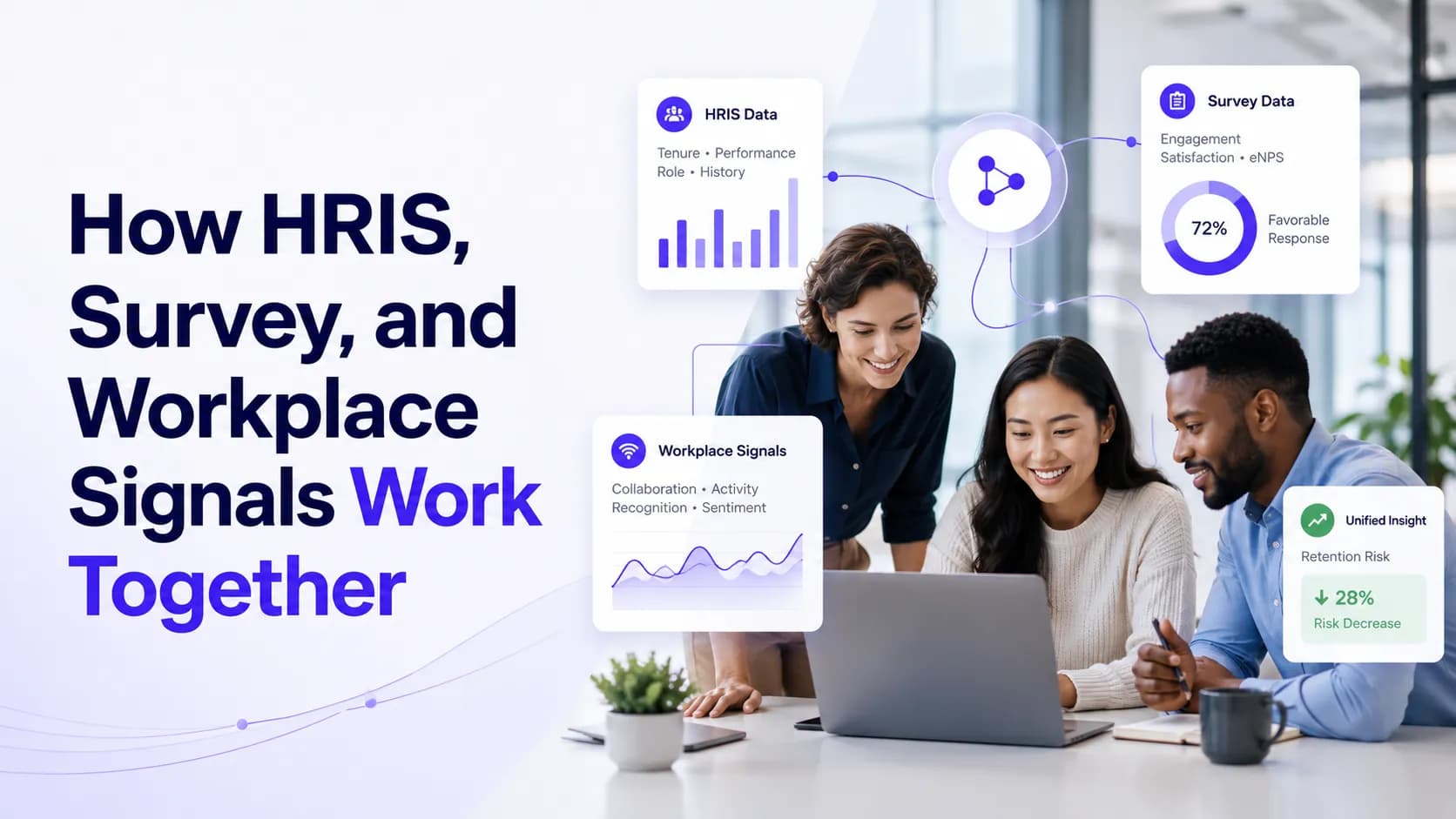
One signal is a guess. The combination is a case. Here is why no single data source is enough to understand retention risk, and how HRIS, survey, and workplace signals plus manager context create the accuracy each one lacks alone.
Every retention data source has a blind spot. Catch Up AI is built around a simple idea: People teams should not have to wait for a resignation, a late survey result, or a manager escalation before they understand what is changing inside a team.
HRIS knows the facts of someone's employment but not how they feel about it. Surveys know how a team felt during a two week window but not what changed the month after. Workplace signals show shifts in how work happens but not why. Managers know the human context but cannot see the whole workforce at once, or spot a slow trend buried in daily noise.
Used alone, each of these produces confident conclusions that are often wrong. Used together, they produce something more valuable and more honest: a case with enough context to act on.
The strongest retention read comes from four layers, each covering the others' gaps:
HRIS Data + Survey Results + Workplace Signals + Manager Context
Think of it less as adding sources and more as triangulation. Any single source can point in a direction. It takes more than one, pointing the same way, to trust the read enough to act. And it takes the manager to confirm it is real.
HRIS gives you the trajectory. Tenure, manager and role history, promotion timing, compensation, mobility, and performance trend describe the structural situation someone is in. This is the stable backbone, updated continuously and tied to real outcomes.
Surveys give you the felt experience. Engagement and sentiment tell you how people describe their own state, in their own words, at a point in time. This is the layer that catches what structured records never will: whether someone feels valued, whether they see a future, whether something specific is wearing them down.
Workplace signals give you the timing. Between survey cycles, changes in participation, responsiveness, and involvement show movement early, often before it reaches a survey and long before a resignation. Read at an aggregated, respectful level, this is the layer that buys you time.
Manager context gives you the truth check. Only the manager knows that the drop in collaboration is a launch crunch, or that the sentiment dip already resolved itself, or that a stretch assignment explains everything. This is the layer that turns a data pattern into a real situation.
Picture three scenarios that look identical in a single source and turn out completely different once the others are added.
A survey shows a team scoring lower than last quarter. Alarming on its own. Add HRIS and you see the team just absorbed a reorg and two manager changes, which explains the dip and points to a specific, fixable cause. Add manager context and you learn the team already talked it through and morale is recovering. The survey alone would have sent you chasing the wrong problem.
A workplace signal shows one person's collaboration dropping sharply. Add HRIS and you see they were just moved onto a solo research project, which explains it entirely. No risk, just a change of work.
HRIS shows a strong performer, long tenure, no recent promotion. Concerning. Add survey sentiment trending down and workplace participation quietly falling, and the picture sharpens from possible to probable. Add manager context confirming the person has mentioned feeling stuck, and you no longer have a data point. You have a case, and a clear reason to have a conversation this week.
The lesson repeats every time. A single signal generates false alarms and false comfort in equal measure. The combination is what separates real, actionable risk from noise.
Combining sources does not make retention predictable with certainty, and that is not the goal. It makes the read honest. It tells you not just that risk may exist, but why, how strong the evidence is, and which parts still need a human to confirm. That confidence level is what lets a People team prioritize, and it is what lets a manager trust the case enough to act rather than dismiss it.
The manager check is not a formality at the end. It is the fourth data layer, and it is what keeps the whole approach grounded in reality and in human judgment. We go deeper on that step in manager action.
Here is the encouraging part. Almost every company of any size already produces all four layers. You run an HRIS. You run engagement surveys. Your teams work in tools that generate collaboration signals. Your managers hold the context in their heads. The layers exist. They are simply disconnected, reviewed separately, and rarely brought together into one view.
That connection is the whole idea behind retention forecasting, covered in full in the pillar guide, retention forecasting. And if you want to understand the single richest of these layers on its own, start with HRIS signals.
Catch Up AI does not replace any of these systems. It reads from the ones you already run, brings their signals into one place, and keeps your managers in control of the final read. For teams that want to turn early patterns into safer manager action, Flight Risk Intelligence connects those signals without turning people into scores.
Most teams are stronger in one or two layers and thin in the others. A Retention Forecast Review maps your current coverage across HRIS, survey, and workplace signals, shows where the blind spots are, and where combining what you already have would sharpen the picture. Twenty minutes, and not a product demo.
If your team wants to see what its existing retention data already reveals, assess coverage.
Continue reading more insights from CatchUp AI