Catch Up AI Selected as a Venture Atlanta 2026 Showcase Company
Catch Up AI has been selected as a Venture Atlanta 2026 Showcase Company, recognizing its AI management layer for performance and retention.
September 10, 2026
Detecting retention risk is only the first step. Learn where retention workflows break between a risk alert and real manager action, and how to close the gap.
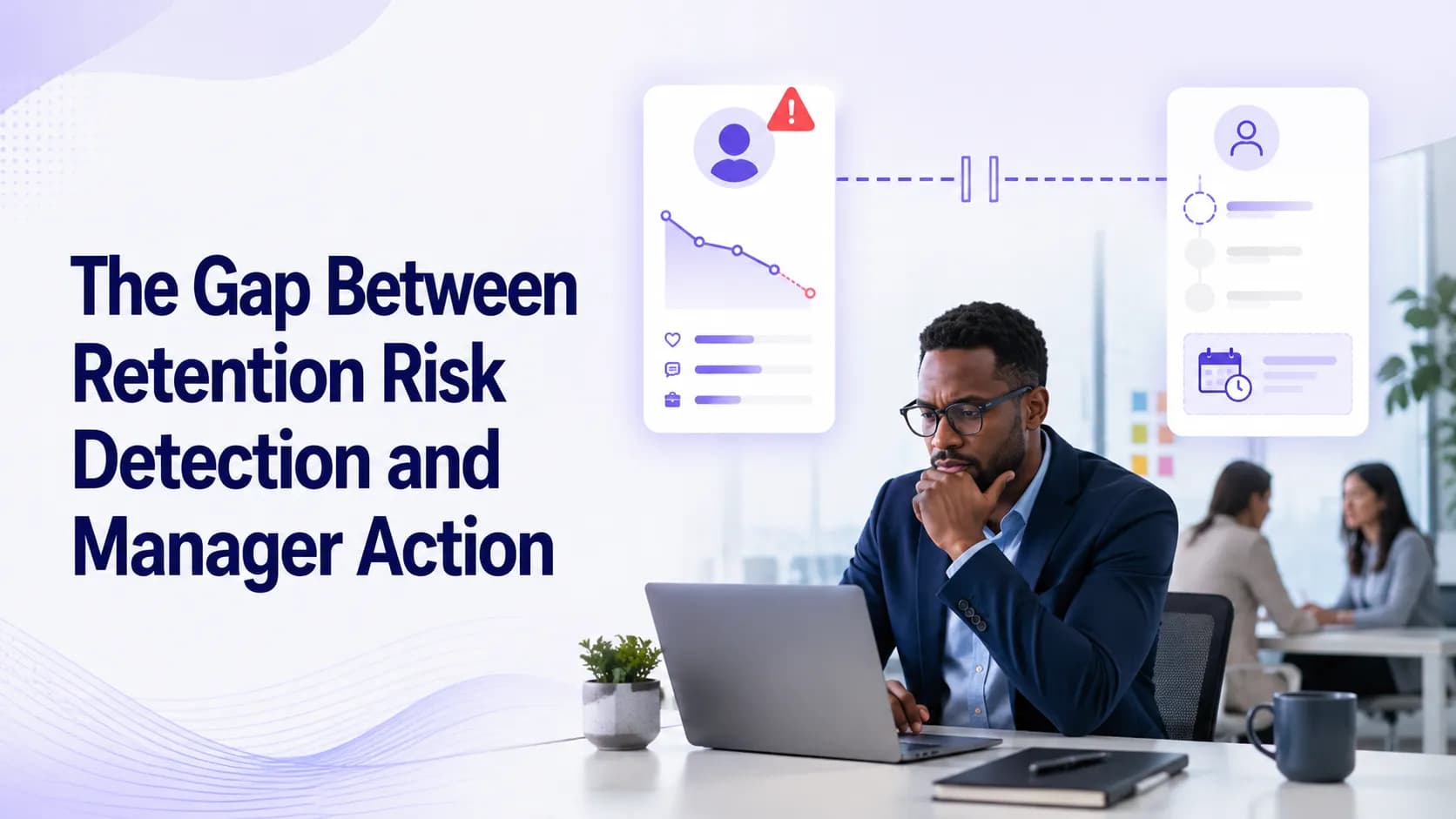
Detecting risk is the easy part. The value leaks out in the five steps between an alert and a manager actually doing something. Here is where retention workflows break, and how to close the gap.
Retention technology has gotten very good at detection. Dashboards flag at risk employees, models produce risk scores, and reports land in inboxes on schedule. Detection is close to solved.
At Catch Up AI, the harder pattern we see is what happens after the alert. Good people still leave, often from teams that already had a dashboard showing what was coming. The problem is no longer seeing the risk. The problem is the distance between seeing it and doing something about it. That distance is where retention programs quietly fail, and almost nobody measures it.
A dashboard is a place risk goes to be observed, not resolved. It shows a score, and it assumes that visibility will produce action. It rarely does, for reasons that have nothing to do with how good the dashboard is.
A busy manager does not open an analytics tool on a Tuesday morning. Even if they do, a score with no explanation gives them nothing to act on. And even if the explanation is there, the dashboard does not tell them what to do, who owns it, or by when. So the score sits there, accurate and ignored, until it becomes a resignation.
Detection creates awareness. Awareness is not action. Everything that has to happen between the two is where the work actually is.
Follow the life of a typical retention alert and you can see exactly where it dies.
The alert fires. It reaches HR, or a manager, or both. Someone reads it and thinks they should probably look into that. Then a real week happens. The alert is not urgent in the way a deadline is urgent, so it slips. If someone does raise it, the conversation is often about the score itself rather than the person, because the context to make it human was never attached. Nobody is quite sure whether it is HR's job or the manager's job to act. And because no action was recorded, no one notices that nothing happened until it is too late.
None of this is negligence. It is what happens to any signal that arrives without context, ownership, or a next step. The alert did its job. The workflow around it did not exist.
The gap between detection and action is not one problem. It is five, and a program has to close all of them.
1. Validation. Who confirms the risk is real? A raw alert mixes genuine risk with noise and incomplete data. Without a validation step, managers either chase false alarms until they stop trusting the tool, or dismiss everything to be safe. Someone has to look at the evidence and say yes, this matches reality, or no, there is a simple explanation. The person best placed to do that is the manager, which is why validation has to be built into the flow rather than assumed.
2. Context. Why is this person at risk? A score without a reason cannot be acted on. Managers need the specific factors behind the risk, drawn from the actual signals, so the conversation can be about the person's real situation rather than an abstract number. Context is what makes an alert usable.
3. Ownership. Who owns the next action? This is the single most common failure point. When responsibility sits ambiguously between HR and the manager, it lands on neither. Every validated case needs one named owner, so it cannot fall into the space between roles.
4. Action. What exactly should happen next? Even a motivated owner stalls at the blank page. Telling a manager to check in is not an action. It is a category. The workflow has to provide a specific, context aware next step: what to raise, what to acknowledge, what to avoid, and roughly when. We cover what good manager action looks like in the follow up framework.
5. Follow up. How is it recorded and measured? If the conversation happens but is never captured, the case still effectively disappears. Follow up records that the action was taken, tracks whether the situation improved, and feeds what you learned back into the process. Without it, you cannot tell a save from a lucky guess, and you cannot get better.
Closing the gap means treating retention as a workflow, not a report. The full loop looks like this:
Detect, Prioritize, Explain, Validate, Assign, Act, Follow Up.
Detection is only the first step, and it is the step everyone already has. The competitive difference now is everything after it. A team that detects perfectly and stops loses to a team that detects adequately and closes the loop, because only one of them actually changes outcomes.
This is the core idea behind retention forecasting. Catch Up AI is built around this loop specifically. It does not replace your existing detection or your HRIS. It adds validation, context, ownership, action, and follow up so a signal can become a resolved case, with managers still in control.
For teams that want this workflow inside their existing people systems, Flight Risk Intelligence connects risk signals to context, validation, and next action without treating people like scores.
Most teams can point to their detection. Far fewer can say who validates a risk, who owns the next action, and how follow up is recorded. A Retention Forecast Review walks through your current workflow end to end and shows you exactly which of the five steps is missing. It takes twenty minutes and it is not a product demo.
If your team wants to find the exact point where risk detection stops turning into action, review workflow.
Continue reading more insights from CatchUp AI