Catch Up AI Selected as a Venture Atlanta 2026 Showcase Company
Catch Up AI has been selected as a Venture Atlanta 2026 Showcase Company, recognizing its AI management layer for performance and retention.
September 10, 2026
A complete guide to retention forecasting, from HRIS, survey, and workplace signals to validated manager action and measurable follow-up.
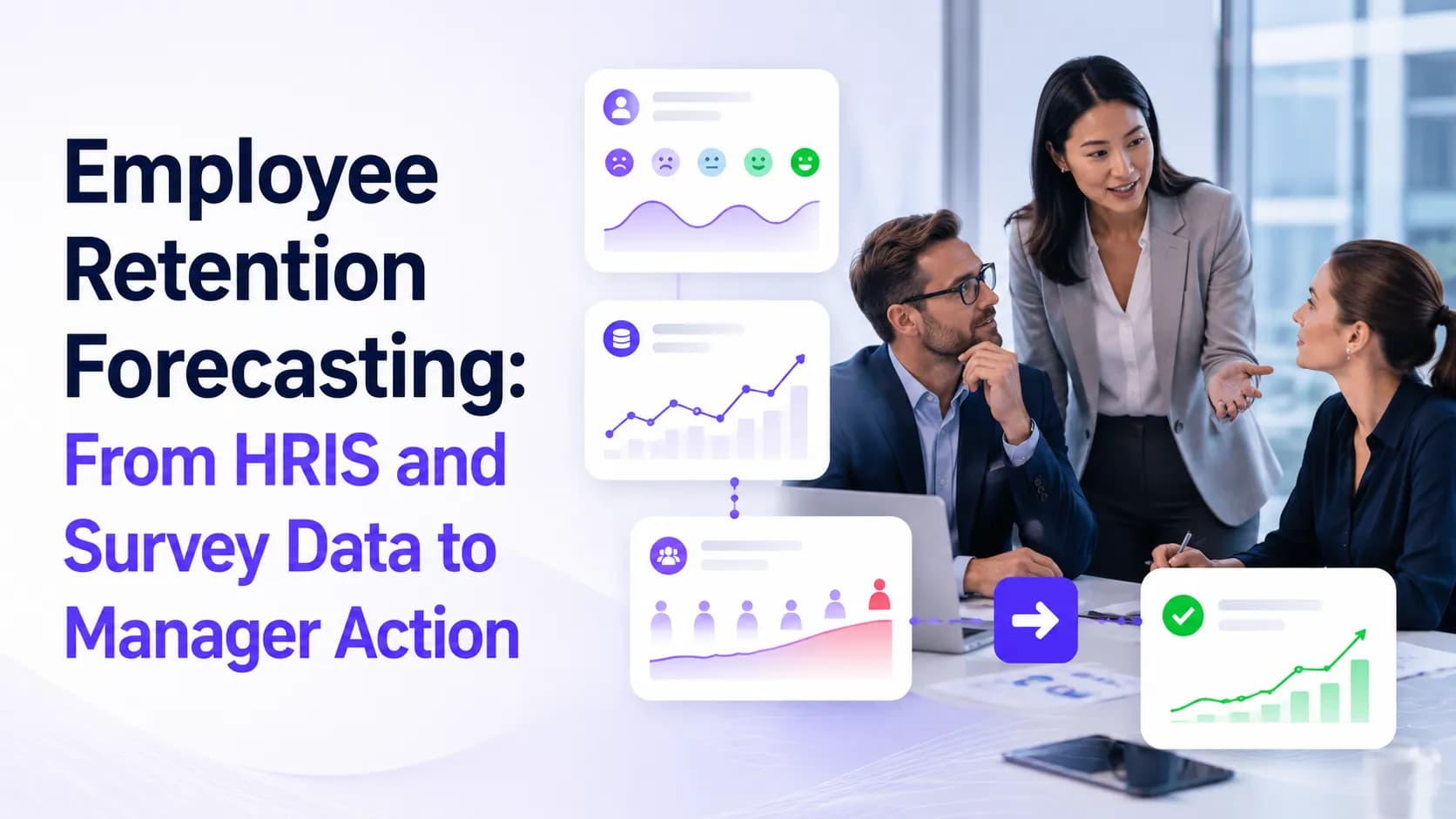
The signals that predict who leaves are already sitting in your systems. The hard part is turning them into a decision a manager can act on this week. This is the complete guide to how retention forecasting works, what data it uses, and how a risk becomes an owned action.
Most People teams do not have a data problem. They have an action problem. For teams using Catch Up AI, the real opportunity is turning scattered people signals into manager action while there is still time to help.
By the time a valued employee hands in their notice, the early signs were usually there for weeks. A drop in participation. A shift in tone during a survey. A change of manager three months ago that nobody connected to anything. The information existed. It just lived in different systems, reached the wrong people, and never turned into a clear next step.
Retention forecasting is the discipline of closing that gap. It is not a crystal ball, and it is not surveillance. It is a way to bring the signals you already generate into one place, understand what they mean together, and hand managers a specific, human action while there is still time to take it.
This guide walks through what retention forecasting actually is, the data it draws on, how a potential risk gets validated, and how the loop closes with measurable manager follow up.
Retention forecasting is the practice of estimating where attrition risk is building across your workforce, explaining the factors behind it, and prioritizing which cases deserve attention first.
The word forecasting matters. A forecast is a probability, not a certainty. No responsible system can tell you that a specific person will resign on a specific date, and any vendor who promises that is overselling. What a good forecast can do is give you earlier visibility and better context, so you move from reacting to resignations to anticipating the moments where a good conversation still changes the outcome.
The difference between a forecast and a plain risk score is what comes attached to it. A responsible flight risk view does not stop at a number on a dashboard telling you something is wrong. A forecast that is useful tells you who, why, how confident the read is, and what a manager might reasonably do next. That last part is where most tools stop and most value is lost.
Retention risk is rarely explained by a single source. The strongest forecasts combine four kinds of input, each of which fills a gap the others leave.
HRIS and people data. The structured facts of someone's employment. Tenure, role and manager history, promotion timing, compensation changes, internal moves, and absence patterns. This is the backbone, because it is consistent and already maintained.
Survey and engagement data. How people say they feel. Engagement scores, pulse responses, sentiment on open text, and the direction of travel over time. This adds the human layer that HRIS records cannot capture on their own.
Workplace and collaboration signals. How work actually happens day to day, drawn from the tools teams already use such as messaging platforms, meetings, and engineering or project systems. These signals are read at an aggregated, respectful level, and they help show change before it reaches a survey cycle.
Manager context. The judgment only a manager has. Whether someone just took on a stretch project, is covering for a colleague, or recently had a difficult conversation. This is the context that turns a data point into a real situation.
Catch Up AI does not replace any of these systems. It reads from the ones you already run and brings their signals into a single view. You can see how these sources reinforce each other in more detail in How HRIS, Survey, and Workplace Signals Work Together.
HRIS data is the most underused retention asset most companies own. It is already collected, already trusted, and already tied to real outcomes.
Fields that carry retention signal include tenure and time in role, recent manager changes, role changes, promotion history, absence trends, compensation adjustments, internal mobility, and performance patterns over time. On their own, each is just a fact. In combination, they describe a trajectory. Someone eighteen months in role, two managers deep, passed over in the last promotion cycle, is a different situation from someone in the same role who was promoted last quarter.
The reason HRIS signal often goes unused is not the data. It is that reading it across all these fields, for every employee, every week, is not something a busy People team can do by hand. We cover which fields matter and how to read them in What HRIS Data Can Reveal About Employee Retention Risk.
Engagement surveys are essential, and they are also easy to misread when used alone.
A survey is a snapshot taken on a schedule. It tells you how a team felt during the window it was open, filtered through who chose to respond and how honest they felt they could be. That is genuinely valuable, and it is also incomplete. Sentiment can shift the week after a survey closes. A high scoring team can still lose its most important person. A quiet score can hide one individual whose situation is changing fast.
Surveys are strongest when they are one input among several rather than the single source of truth. Paired with HRIS trajectory and current workplace signals, a survey response stops being an isolated number and becomes part of a fuller picture. The point is not to trust surveys less. It is to give them the context that lets you act on them with confidence.
Between survey cycles, work still leaves a trace. Participation in team rituals, responsiveness, the rhythm of collaboration, and involvement in projects all shift when someone is quietly disengaging. Read carefully and at the right level, these signals are the earliest warning available, often visible before the next survey and long before a resignation.
The critical distinction here is aggregated pattern versus individual monitoring. Retention forecasting done responsibly looks at meaningful changes in patterns to prompt a supportive human conversation. It does not read private messages or surveil individuals, and it should never be positioned that way. The goal is to help a manager notice sooner, not to watch anyone.
A forecast is a starting point, not a verdict. Before anyone acts, a potential risk has to be checked against reality, and the person best placed to do that is almost always the manager.
Validation is the step where the system says here is what the signals suggest and why, and the manager says that matches what I am seeing, or actually there is a simple explanation. Someone whose collaboration dropped may be heads down on a launch. Someone whose sentiment dipped may have just resolved the thing that caused it. Validation separates real, actionable risk from noise and incomplete data, and it keeps managers in control of the judgment rather than reacting to an alert they cannot interrogate.
This is also where trust is won or lost. A tool that fires alerts managers cannot question gets ignored within a month. A tool that shows its evidence and invites a human check earns its place in the workflow.
Once a risk is validated, the question every People leader knows too well is: now what? This is the exact point where most retention programs stall. The risk is real, everyone agrees, and then nothing specific happens because no single action is owned.
Retention forecasting closes this by attaching a recommended next action to the validated case and assigning an owner. Not a generic reminder to check in, but a specific, context aware suggestion: what to raise, what to acknowledge, what to avoid leading with, and when. The manager stays the decision maker. The system removes the blank page.
We break down exactly what a manager should do, step by step, in What Should Managers Do After a Retention Risk Is Identified?, and why the handoff from detection to action fails so often in The Gap Between Retention Risk Detection and Manager Action.
An action you cannot see is an action you cannot trust. The final piece of retention forecasting is closing the loop: recording that the conversation happened, capturing the outcome, and tracking whether the situation improved.
Measurable follow up does two things. It makes the process accountable in the moment, so a case does not quietly disappear between roles. And it makes the process better over time, because you learn which actions actually helped and which risks were false alarms. Over enough cycles, that feedback sharpens both the forecast and the recommendations. Follow up is not administrative overhead. It is what turns a one time save into a repeatable capability.
Put together, retention forecasting is a loop, not a report:
Detect to Prioritize to Explain to Validate to Assign to Act to Follow Up
Detect brings the signals together. Prioritize focuses attention. Explain shows the evidence. Validate keeps the manager in control. Assign gives the case an owner. Act provides a specific next step. Follow Up closes the loop and feeds the next cycle.
Every stage matters, because the value leaks out wherever the chain breaks. A great forecast with no owner is a missed conversation. A perfect action with no follow up is a lesson never learned.
You do not need a new system to begin. You need a clear picture of the signals you already have, how they flow to managers today, and where the chain breaks between spotting a risk and acting on it.
That is exactly what a Retention Forecast Review looks at. In twenty focused minutes we walk through your current HRIS, survey, and workplace data, your validation and follow up process, and the specific gaps between identifying a risk and taking action. It is not a product demo, and you keep the takeaways either way. If you want to know what the session covers before booking, read Retention Forecast Review.
If you want to see where your current signals already exist and where action breaks down, book a review.
Continue reading more insights from CatchUp AI